
The guinea pigs have arrived, find out why
By M Mistry | October 27th, 2026

Choosing health benefits for a large diverse workforce
For large employers, choosing health benefits that work well for a diverse workforce can be a challenge. A workforce spread across different sites, roles and working patterns rarely has one uniform set of health needs. Office-based employees, shift workers and mobile teams may have varying priorities, needs and may face different barriers to accessing care. A benefit that looks comprehensive on paper will be less valuable if it does not reflect how people actually work and use healthcare.
For a large employer, the challenge is to provide relevant support without paying for benefits that employees are unlikely to use. BHSF’s Tailored Health & Wellbeing Plan is well positioned for organisations with 200 or more employees. Rather than starting with a fixed package, employers can consider and discuss which cash plan benefits to include and how to shape the plan around their workforce needs and budget.
A tailored plan begins with the employer’s objectives and the needs of its people. One organisation may want to help with the cost of everyday dental, optical and physiotherapy appointments. Another may be reviewing how its existing benefits work together or trying to make health support more relevant across multiple locations.
With BHSF, large employers can select or customise cash plan benefits. Under a health cash plan, employees typically pay for eligible care, submit a claim and receive money back up to the limit of their cover. The final benefits, limits and any additional services should be clearly set out in the agreed plan, so everyone knows exactly what’s included rather than making assumptions from a standard product description.
Therefore, tailoring is more than just choosing a list of benefits. It means deciding what support employees should receive, how the organisation will fund it and how people will understand and access it.
Before choosing cover, identify what the plan is intended to achieve. Is the priority to help with routine healthcare costs, improve the relevance of your benefits package or give employees clearer routes to support? A goal such as “improve wellbeing” is a useful starting point, but it’s too broad to guide every decision on its own.
Bring together information you already have such as employee feedback, questions received by HR, existing benefits take-up and any differences across sites, roles or job types. Ask which healthcare expenses employees would value help with and whether working patterns affect how easily they can access and use the support available. This helps you, as an employer distinguish between benefits that sound appealing from those that address a more practical need.
For example, employees in a multi-site organisation may have very different working days, yet both groups could value cashback for glasses or dental care. The benefit may be shared, while the way you explain and promote it needs to differ. BHSF presents its tailored plan as a way to make cover more relevant to a diverse workforce, rather than relying on a one-size-fits-all approach.
BHSF wider business health cash plan offers a number of health and wellbeing benefits, with the flexibility to tailor the plan to suit your business and workforce.
These can be a useful starting point for discussion, but employers should confirm exactly which benefits and services can be included in their tailored proposal.
When reviewing your options, consider both relevance and clarity. Employees are more likely to value benefits when they understand what is covered, how much they can claim and whether a service is included in their plan. It is better to offer a selection of benefits people understand and can use, rather than to promote a long list of options without clear information about what they include.
If you already provide private medical insurance (PMI), consider the role of each benefit. A health cash plan is generally aimed at defined everyday expenses, while PMI covers eligible private medical treatment under its policy terms. The two may work alongside one another, but employee communications should make the distinction clear, so staff know which route applies to their needs.
Funding affects both the employer’s budget and the employee experience. BHSF offers employer-paid, employee-paid and hybrid approaches for its tailored business health plans. The right arrangement depends on the level of support the organisation wants to provide and how much choice it wants to offer to employees.
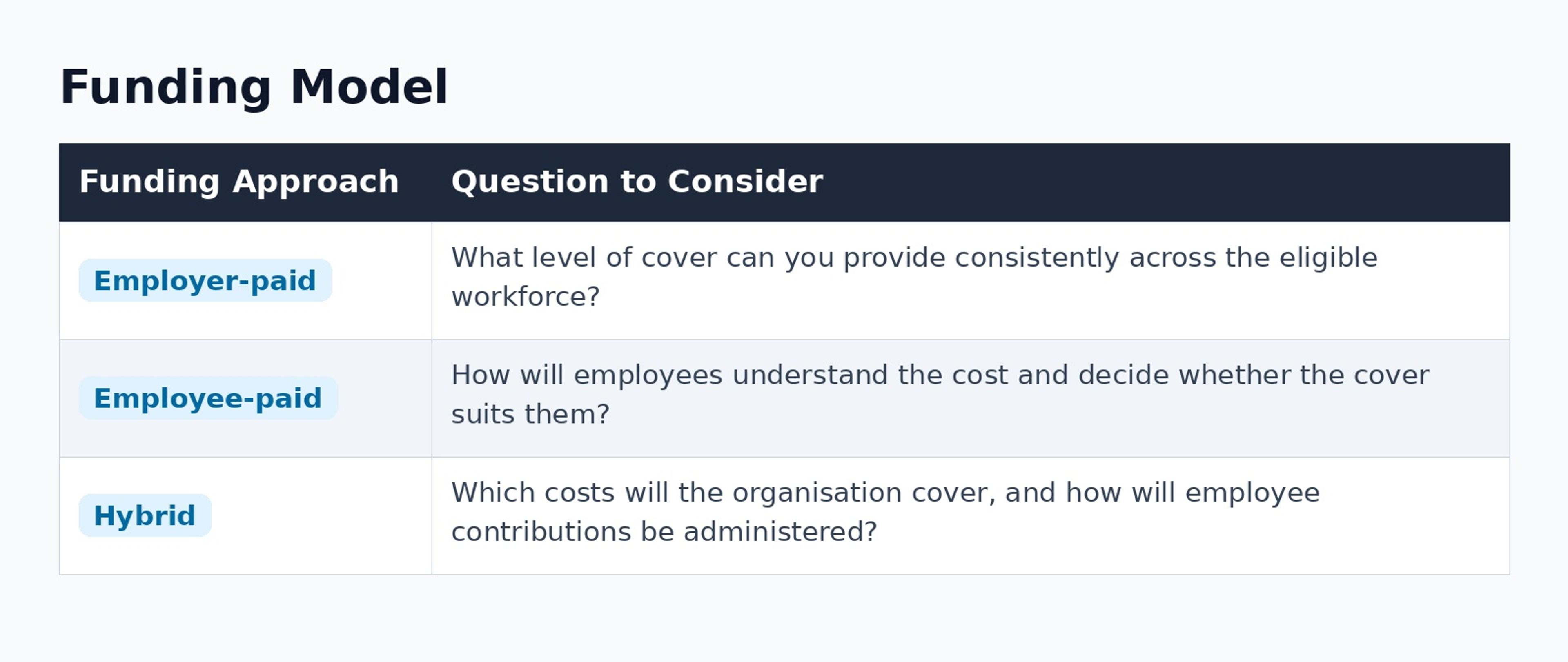
Different funding approaches for health & wellbeing plans
Ask for a proposal that shows more than a headline price. You will need to understand the total employer cost, the benefits employees would receive, any available choices and what the arrangement requires from payroll and HR. Confirm the tax and reporting treatment of the proposed setup with your advisers before launch.
A tailored benefit still needs a straightforward rollout. Agree who will be eligible, when cover begins, what employee information is needed and who owns each part of the implementation. For a large employer, HR, payroll, benefits teams and local managers may all have a role.
Communications can address the practical questions employees are likely to ask such as: Am I covered? What can I claim for? What are the limits? How do I submit a claim? Where do I go for help? Use language and a mix of formats that work across your organisation, including for employees who may not spend their working day at a computer.
BHSF can provide marketing support to help employers engage with their teams with a tailored plan. Ask what materials and implementation support would be included in your proposal and establish who will handle employee queries once the plan is live.
A successful launch is only the beginning. Set a review point to examine whether employees understand the cover, which benefits they use and what questions are coming back to HR or managers. Feedback from different sites can reveal whether a benefit is relevant across the workforce or whether communications need improving.
Keep the measures tied to your original objectives. If you introduced a plan to help employees manage everyday healthcare costs, look for evidence that they know how to claim and are using relevant benefits. If absence or retention is part of your business case, monitor those trends too, Workforce health and employment outcomes are influenced by many factors.
The advantage of a tailored approach is the opportunity to begin with your organisation’s actual needs rather than a generic idea of what a large workforce should want. Define the priorities, confirm the cover and funding in your proposal, and make the benefit easy for employees to use.
Next step: Speak to BHSF about a tailored health and wellbeing plan for your workforce.

Explore affordable health plans for teams of 3–9. Help employ...Explore affordable health plans for teams of 3–9. Help employees with everyday healthcare costs, co...
Read moreHealth cash plan or PMI? Compare costs, cover and value to fi...Health cash plan or PMI? Compare costs, cover and value to find the right staff health benefit for ...
Read moreWe’ve all heard of burnout, but what about boreout? While bur...We’ve all heard of burnout, but what about boreout? While burnout steals the spotlight, boreout is ...
Read moreFrom introverts to extroverts, every personality type deserve...From introverts to extroverts, every personality type deserves space to thrive. BHSF looks at how e...
Read more